Redwall
“Children's books about woodland mice that are shamelessly, gloriously violent.”
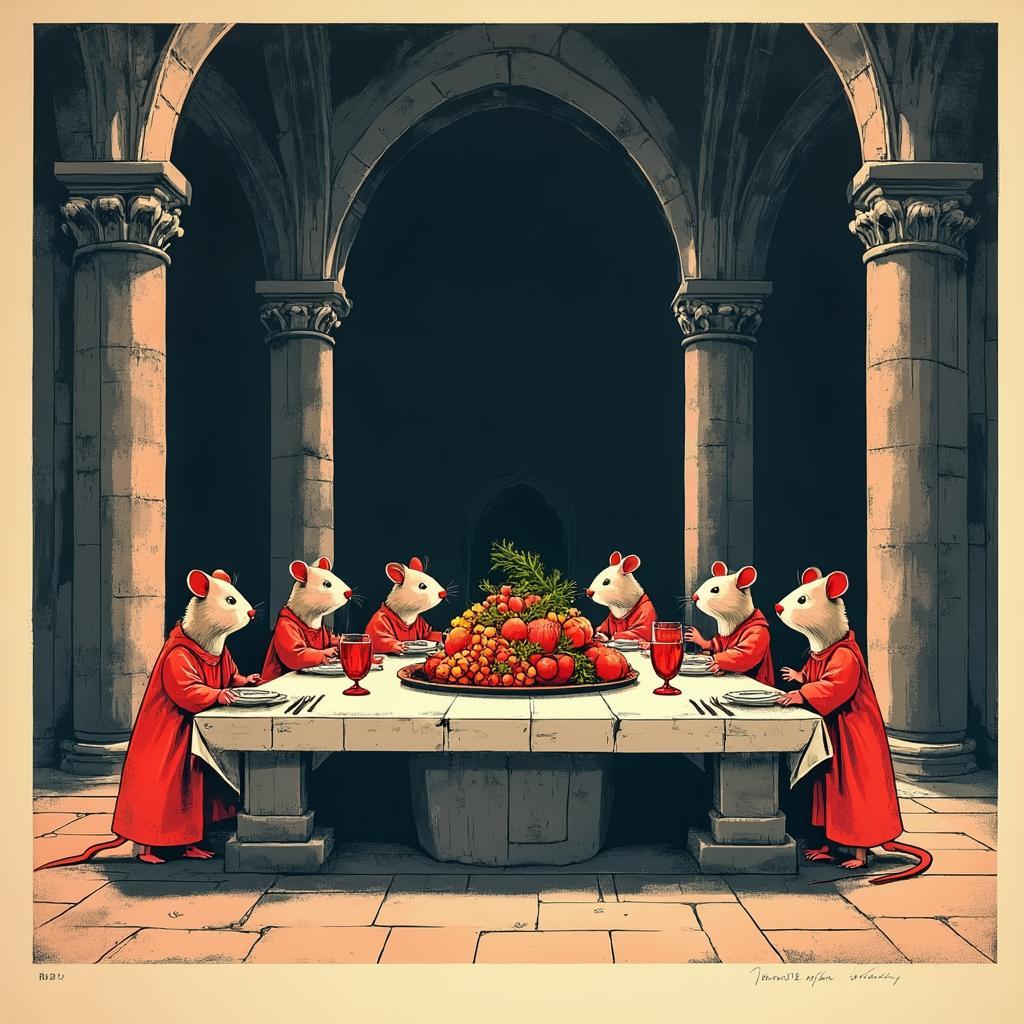
- if you love BG3's depth of world detail but don't read fantasy
- if you think children's books can't be properly violent
- if you bounced off epic fantasy after one too many chosen ones
- if you want a book to read aloud that won't bore you
You don’t read children’s books about mice. I know. Woodland creatures with swords, talking badgers, a title that sounds like it belongs on a primary school shelf between Blyton and Roald Dahl. You saw the covers twenty years ago and filed them away, and you’ve never once considered going back.
Go back.
The first Redwall book opens with Cluny the Scourge — a rat warlord who drags a war cart pulled by weasels across the countryside, wielding a poisoned barb tail, sacking everything in his path — arriving at a peaceful abbey of mice. What follows is a siege story, properly constructed, with tunnels and betrayals and a young novice mouse called Matthias who has to find a legendary hero’s sword before the gates fall. Children’s book, technically. Also a book where villains get skewered, flung from ramparts, eaten by an adder, and where one serial kidnapper works a slave chain of children across the countryside. Jacques never wrote down to anyone. The body count in these things would raise eyebrows in adult fantasy.
And the violence isn’t even the best bit — it’s a symptom of the best bit, which is the density. Twenty-two books covering generations of the same world, centuries of history, family trees, prophecies that pay off books later, and a whole constructed geography of Mossflower you’ll hold in your head the way you hold Faerûn or Novigrad. Here’s the mechanism, and it’s a lovely bit of cynical trivia: Jacques wrote the first book for children at the Royal Wavertree School for the Blind in Liverpool, so he couldn’t rely on pictures. Everything had to be carried by description. Which is why the feasts go on for pages — the deeper-than-deep hot root and meadowcream and October Ale — and why every corridor and rampart is somewhere you can actually walk. It’s a world built entirely out of prose, and it holds up read as an adult, unironically. If you’re the sort of person who reads item descriptions and lore notes in Baldur’s Gate 3, this is the same appetite, aimed at a badger with a war horn.
There’s a trap here and it’s the one you’re already thinking of: this isn’t nostalgia. Nobody’s asking you to feel six again. The books are structurally honest — quests fail, characters die mid-arc, the villains are genuinely frightening rather than Saturday-morning — and the writing has a Liverpudlian warmth and humour that cuts against the cosiness. The abbey feels like somewhere worth defending precisely because Jacques keeps showing you what happens when it isn’t.
Start with Redwall or Mossflower — the series is mostly standalone, which is its own gift. Read it in an afternoon, then work through the rest at whatever speed your dignity allows. And if you’ve got kids in your life, so much the better: it’s an excuse. But that’s all it is.
The shelf it sits on doesn’t matter. The siege does.