Severance
“Your job already splits you in two. This makes it literal.”
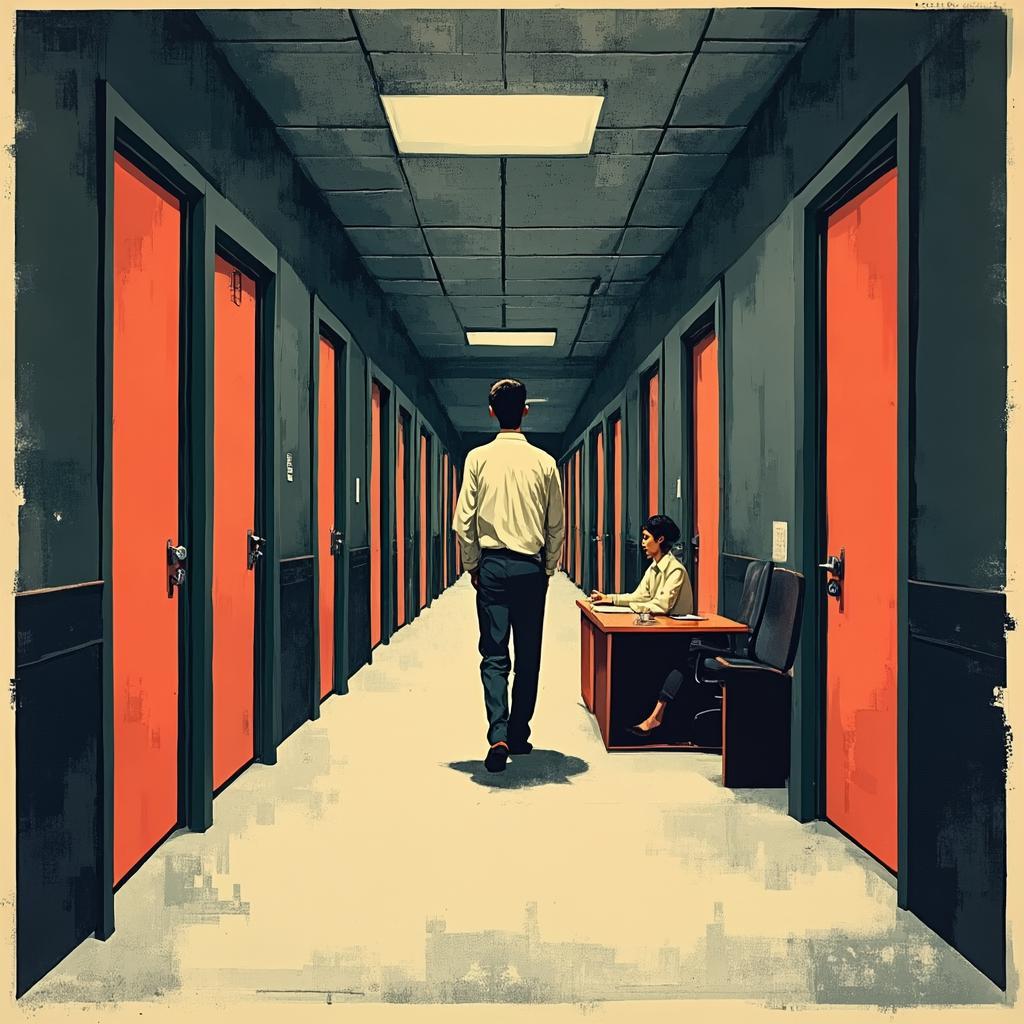
- if you don't watch sci-fi
- if you think Apple TV+ shows are all prestige wallpaper
- if you've ever felt your work self and home self were different people
You don’t watch sci-fi. I know. It’s the trimmings you’re allergic to — the spaceship bridges, the technobabble, the exposition delivered by a man in a rubber forehead. It all sounds like homework with a fandom attached, and you’ve got a real job and a real life and neither needs a second one.
Here’s the trick: Severance is a real job. That’s the whole horror of it.
Mark works at Lumon Industries. On his first day, he had a procedure — a chip in his head that surgically divides his memories. When he’s at work, he’s an “innie”: he exists only inside Lumon, forever, doing mysterious tasks on a computer for reasons nobody will explain. When he’s home, he’s the “outie”: he has no memory of what he does all day. Eight hours vanish. He collects a salary. His work self collects nothing — no weekends, no holidays, no exit. The innie wakes up in the lift, walks to his desk, and lives the same corridors until he dies, one elevator ride at a time.
If your gut just said “that’s the worst idea I’ve ever heard,” congratulations — you already understand the show. The science-fiction element is one procedure, and everything around it is played as office realism: the beige corridors of a 1970s corporate campus, the Wellness sessions, the inexplicable devotion of middle management, a reward system built on finger traps and waffle parties. The production design is doing enormous work — everything is just slightly off, slightly sterile, and the wrongness accumulates like damp. Ben Stiller directs most of it, and he shoots it like a thriller that’s frightened of daylight.
What makes it sing is that it’s not really about the mystery of what Lumon does. It’s about the mystery of what Lumon is — a machine for extracting labour from people who never consented to the labour, with a smile and a plant on every desk. The innies are effectively prisoners born at 9am. One of them is a new consciousness that has existed for three months and will never see the sky. The show takes the commute-metaphor of corporate life and makes it a cell, then asks the question you’d actually ask: how do you escape a prison that only exists for eight hours a day, and isn’t that most jobs anyway?
Britt Lower and Adam Scott are superb as the two halves of the same woman and man — the same person, with none of the same memories, played as entirely different characters. John Torkington— no, John Turturro, and Christopher Walken, give it the saddest workplace romance on television. Tramell Tillman’s Mr. Milchick is one of the great TV management performances: supportive, corporate, and utterly chilling, sometimes within a single sentence.
Season two came out in 2025, the whole thing lives on Apple TV+, and it’s the rare prestige show where the answers to the mystery are worth the wait.
You already live this show. Watch it happen to someone else.